
Overview variants
Cultivation of silage maize, winter wheat and winter rape under the influence of omitted fertilisation with the nutrient elements nitrogen (N), phosphorus (P) and potassium (K) as well as the influence of omitted liming.
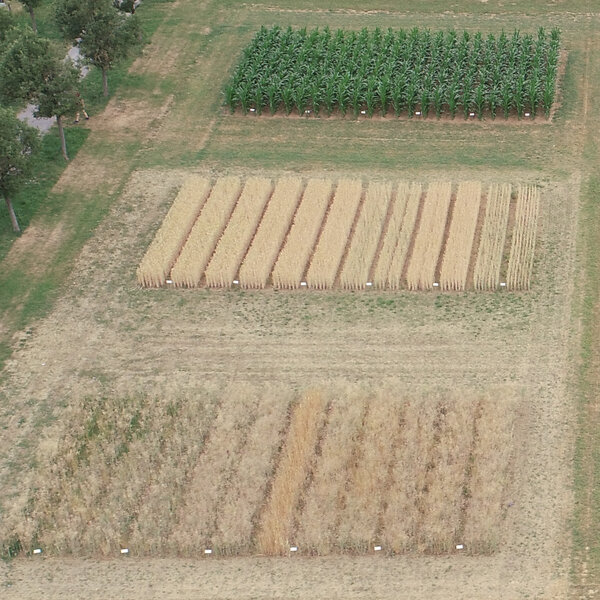
Cultivation of silage maize, winter wheat and winter rape under the influence of omitted fertilisation with the nutrient elements nitrogen (N), phosphorus (P) and potassium (K) as well as the influence of omitted liming.
Go to content:
Growth habit:
A winter annual crop with a strong taproot.
Initially forms a basal leaf rosette in autumn; the stem usually remains strongly compressed before winter.
After overwintering, an upright stem develops, branching particularly in its upper part.
Often reaches a height of approximately 100–180 cm at flowering, depending on the cultivar and growing conditions.
Leaves:
Usually bluish-green with a waxy bloom of variable intensity.
Lower leaves:
Stalked, relatively large, usually lyrately lobed to pinnatifid, with a large terminal lobe and smaller lateral lobes; hairless to sparsely hairy.
Upper leaves:
Smaller, undivided, oblong to lanceolate and mostly hairless; sessile, with a broadened, auriculate base partially clasping the stem.
Flowers:
Yellow flowers with four sepals and four petals arranged in a cross.
Six stamens: four long and two short.
Flowers are borne in terminal racemes that elongate during flowering.
The flower buds at the tip usually project above the open flowers.
Fruits and fruiting structure:
Long, narrow siliques (seed pods) with a short terminal beak and numerous seeds.
Stalked siliques are arranged in fruiting racemes on the main stem and lateral branches.
Within each fruiting raceme, ripening generally progresses from the bottom upwards.
Seeds:
Small, rounded to spherical, usually dark brown to black.
| Type | Winter rape (hybrid) |
| Variety | KWS Ambos |
| Grains/m2 | 55 |
| TKG | 5,13 |
| KFxFA % | 79,9 |
| Seed rate kg/ha | 3,5 |
| Measures | Sowing: 03.09.2026 Cambridge rolling: 03.09.2026 Emergence: 14.09.2026 |
| Fertilisation | 08.08.2019 30 kg/ha P (triple superphosphate 45%) 30 kg/ha K (grain potash 60%) to maize 03.08.2021 30 kg/ha P (triple superphosphate 45%) 30 kg/ha K (grain potash 60%) to winter rape 21.02.2023 40 kg/ha P (triple superphosphate 45%) 40 kg/ha K (grain potash 60%) to winter wheat 04.09.2023 60 kg/ha P (triple superphosphate 45%) 40 kg/ha K (grain potash 60%) to winter rape 08.09.2026 80 kg/ha P (Triple-Superphosphat 45%) 130 kg/ha K (Korn-Kali 60%) to winter rape 24.09.2026 30 kg/ha N (Kalkammonsalpeter 27%) to winter rape |
| Plant protection | treated seed 22.09.2026: Herbicide 0,25 l/ha LaDiva 15.10.2026: Herbizid 0,25 l/ha Belkar |
Order: Cruciferous (Brassicales)
Family: Cruciferous plants (Brassicaaceae)
Tribus: (Brassiceae)
Genus: Cabbage (Brassica)
Growth habit:
A winter annual crop with a strong taproot.
Initially forms a basal leaf rosette in autumn; the stem usually remains strongly compressed before winter.
After overwintering, an upright stem develops, branching particularly in its upper part.
Often reaches a height of approximately 100–180 cm at flowering, depending on the cultivar and growing conditions.
Leaves:
Usually bluish-green with a waxy bloom of variable intensity.
Lower leaves:
Stalked, relatively large, usually lyrately lobed to pinnatifid, with a large terminal lobe and smaller lateral lobes; hairless to sparsely hairy.
Upper leaves:
Smaller, undivided, oblong to lanceolate and mostly hairless; sessile, with a broadened, auriculate base partially clasping the stem.
Flowers:
Yellow flowers with four sepals and four petals arranged in a cross.
Six stamens: four long and two short.
Flowers are borne in terminal racemes that elongate during flowering.
The flower buds at the tip usually project above the open flowers.
Fruits and fruiting structure:
Long, narrow siliques (seed pods) with a short terminal beak and numerous seeds.
Stalked siliques are arranged in fruiting racemes on the main stem and lateral branches.
Within each fruiting raceme, ripening generally progresses from the bottom upwards.
Seeds:
Small, rounded to spherical, usually dark brown to black.
Order: Cruciferous (Brassicales)
Family: Cruciferous plants (Brassicaaceae)
Tribus: (Brassiceae)
Genus: Cabbage (Brassica)
Growth habit:
A winter annual crop with a strong taproot.
Initially forms a basal leaf rosette in autumn; the stem usually remains strongly compressed before winter.
After overwintering, an upright stem develops, branching particularly in its upper part.
Often reaches a height of approximately 100–180 cm at flowering, depending on the cultivar and growing conditions.
Leaves:
Usually bluish-green with a waxy bloom of variable intensity.
Lower leaves:
Stalked, relatively large, usually lyrately lobed to pinnatifid, with a large terminal lobe and smaller lateral lobes; hairless to sparsely hairy.
Upper leaves:
Smaller, undivided, oblong to lanceolate and mostly hairless; sessile, with a broadened, auriculate base partially clasping the stem.
Flowers:
Yellow flowers with four sepals and four petals arranged in a cross.
Six stamens: four long and two short.
Flowers are borne in terminal racemes that elongate during flowering.
The flower buds at the tip usually project above the open flowers.
Fruits and fruiting structure:
Long, narrow siliques (seed pods) with a short terminal beak and numerous seeds.
Stalked siliques are arranged in fruiting racemes on the main stem and lateral branches.
Within each fruiting raceme, ripening generally progresses from the bottom upwards.
Seeds:
Small, rounded to spherical, usually dark brown to black.
| Type | Winter rape (hybrid) |
| Variety | KWS Ambos |
| Grains/m2 | 55 |
| TKG | 5,13 |
| KFxFA % | 79,9 |
| Seed rate kg/ha | 3,5 |
| Measures | Sowing: 03.09.2026 Cambridge rolling: 03.09.2026 Emergence: 14.09.2026 |
| Fertilisation | 08.08.2019 600 kg/ha CaO (carbolime 27%) 30 kg/ha P (triple superphosphate 45%) 30 kg/ha K (grain potash 60%) to maize 03.08.2021 600 kg/ha CaO (carbolime 27%) 30 kg/ha P (triple superphosphate 45%) 30 kg/ha K (grain potash 60%) to winter rape 21.02.2023 40 kg/ha P (triple superphosphate 45%) 40 kg/ha K (grain potash 60%) to winter wheat 04.09.2023 600 kg/ha CaO (carbonic acid lime 45%) 60 kg/ha P (triple superphosphate 45%) 40 kg/ha K (grain potash 60%) to winter rape 08.09.2026 80 kg/ha P (Triple-Superphosphat 45%) 130 kg/ha K (Korn-Kali 60%) to winter rape 24.09.2026 600 kg/ha CaO (Kohlensaurer Kalk 53%) to winter rape |
| Plant protection | treated seed 22.09.2026: Herbicide 0,25 l/ha LaDiva 15.10.2026: Herbizid 0,25 l/ha Belkar |
Order: Cruciferous (Brassicales)
Family: Cruciferous plants (Brassicaaceae)
Tribus: (Brassiceae)
Genus: Cabbage (Brassica)
Growth habit:
A winter annual crop with a strong taproot.
Initially forms a basal leaf rosette in autumn; the stem usually remains strongly compressed before winter.
After overwintering, an upright stem develops, branching particularly in its upper part.
Often reaches a height of approximately 100–180 cm at flowering, depending on the cultivar and growing conditions.
Leaves:
Usually bluish-green with a waxy bloom of variable intensity.
Lower leaves:
Stalked, relatively large, usually lyrately lobed to pinnatifid, with a large terminal lobe and smaller lateral lobes; hairless to sparsely hairy.
Upper leaves:
Smaller, undivided, oblong to lanceolate and mostly hairless; sessile, with a broadened, auriculate base partially clasping the stem.
Flowers:
Yellow flowers with four sepals and four petals arranged in a cross.
Six stamens: four long and two short.
Flowers are borne in terminal racemes that elongate during flowering.
The flower buds at the tip usually project above the open flowers.
Fruits and fruiting structure:
Long, narrow siliques (seed pods) with a short terminal beak and numerous seeds.
Stalked siliques are arranged in fruiting racemes on the main stem and lateral branches.
Within each fruiting raceme, ripening generally progresses from the bottom upwards.
Seeds:
Small, rounded to spherical, usually dark brown to black.
| Type | Winter rape (hybrid) |
| Variety | KWS Ambos |
| Grains/m2 | 55 |
| TKG | 5,13 |
| KFxFA % | 79,9 |
| Seed rate kg/ha | 3,5 |
| Measures | Sowing: 03.09.2026 Cambridge rolling: 03.09.2026 Emergence: 14.09.2026 |
| Fertilisation | 08.08.2019 600 kg/ha CaO (carbolime 27%) 30 kg/ha P (triple superphosphate 45%) 30 kg/ha K (grain potash 60%) to maize 03.08.2021 600 kg/ha CaO (carbolime 27%) 30 kg/ha P (triple superphosphate 45%) 30 kg/ha K (grain potash 60%) to winter rape 21.02.2023 40 kg/ha P (triple superphosphate 45%) 40 kg/ha K (grain potash 60%) to winter wheat 04.09.2023 600 kg/ha CaO (carbonic acid lime 45%) 60 kg/ha P (triple superphosphate 45%) 40 kg/ha K (grain potash 60%) to winter rape 08.09.2026 80 kg/ha P (Triple-Superphosphat 45%) 130 kg/ha K (Korn-Kali 60%) to winter rape 24.09.2026 600 kg/ha CaO (Kohlensaurer Kalk 53%) to winter rape 24.09.2026 30 kg/ha N (Kalkammonsalpeter 27%) to winter rape |
| Plant protection | treated seed 22.09.2026: Herbicide 0,25 l/ha LaDiva 15.10.2026: Herbizid 0,25 l/ha Belkar |
Order: Cruciferous (Brassicales)
Family: Cruciferous plants (Brassicaaceae)
Tribus: (Brassiceae)
Genus: Cabbage (Brassica)
Growth habit:
A winter annual crop with a strong taproot.
Initially forms a basal leaf rosette in autumn; the stem usually remains strongly compressed before winter.
After overwintering, an upright stem develops, branching particularly in its upper part.
Often reaches a height of approximately 100–180 cm at flowering, depending on the cultivar and growing conditions.
Leaves:
Usually bluish-green with a waxy bloom of variable intensity.
Lower leaves:
Stalked, relatively large, usually lyrately lobed to pinnatifid, with a large terminal lobe and smaller lateral lobes; hairless to sparsely hairy.
Upper leaves:
Smaller, undivided, oblong to lanceolate and mostly hairless; sessile, with a broadened, auriculate base partially clasping the stem.
Flowers:
Yellow flowers with four sepals and four petals arranged in a cross.
Six stamens: four long and two short.
Flowers are borne in terminal racemes that elongate during flowering.
The flower buds at the tip usually project above the open flowers.
Fruits and fruiting structure:
Long, narrow siliques (seed pods) with a short terminal beak and numerous seeds.
Stalked siliques are arranged in fruiting racemes on the main stem and lateral branches.
Within each fruiting raceme, ripening generally progresses from the bottom upwards.
Seeds:
Small, rounded to spherical, usually dark brown to black.
| Type | Winter rape (hybrid) |
| Variety | KWS Ambos |
| Grains/m2 | 55 |
| TKG | 5,13 |
| KFxFA % | 79,9 |
| Seed rate kg/ha | 3,5 |
| Measures | Sowing: 03.09.2026 Cambridge rolling: 03.09.2026 Emergence: 14.09.2026 |
| Fertilisation | 08.08.2019 600 kg/ha CaO (carbolime 27%) 30 kg/ha P (triple superphosphate 45%) to maize 03.08.2021 600 kg/ha CaO (carbolime 27%) 30 kg/ha P (triple superphosphate 45%) to winter rape 21.02.2023 40 kg/ha P (triple superphosphate 45%) to winter wheat 04.09.2023 600 kg/ha CaO (carbonic acid lime 45%) 60 kg/ha P (triple superphosphate 45%) to winter rape 08.09.2026 80 kg/ha P (Triple-Superphosphat 45%) to winter rape 24.09.2026 600 kg/ha CaO (Kohlensaurer Kalk 53%) to winter rape 24.09.2026 30 kg/ha N (Kalkammonsalpeter 27%) to winter rape |
| Plant protection | treated seed 22.09.2026: Herbicide 0,25 l/ha LaDiva 15.10.2026: Herbizid 0,25 l/ha Belkar |
Order: Cruciferous (Brassicales)
Family: Cruciferous plants (Brassicaaceae)
Tribus: (Brassiceae)
Genus: Cabbage (Brassica)
Growth habit:
A winter annual crop with a strong taproot.
Initially forms a basal leaf rosette in autumn; the stem usually remains strongly compressed before winter.
After overwintering, an upright stem develops, branching particularly in its upper part.
Often reaches a height of approximately 100–180 cm at flowering, depending on the cultivar and growing conditions.
Leaves:
Usually bluish-green with a waxy bloom of variable intensity.
Lower leaves:
Stalked, relatively large, usually lyrately lobed to pinnatifid, with a large terminal lobe and smaller lateral lobes; hairless to sparsely hairy.
Upper leaves:
Smaller, undivided, oblong to lanceolate and mostly hairless; sessile, with a broadened, auriculate base partially clasping the stem.
Flowers:
Yellow flowers with four sepals and four petals arranged in a cross.
Six stamens: four long and two short.
Flowers are borne in terminal racemes that elongate during flowering.
The flower buds at the tip usually project above the open flowers.
Fruits and fruiting structure:
Long, narrow siliques (seed pods) with a short terminal beak and numerous seeds.
Stalked siliques are arranged in fruiting racemes on the main stem and lateral branches.
Within each fruiting raceme, ripening generally progresses from the bottom upwards.
Seeds:
Small, rounded to spherical, usually dark brown to black.
| Type | Winter rape (hybrid) |
| Variety | KWS Ambos |
| Grains/m2 | 55 |
| TKG | 5,13 |
| KFxFA % | 79,9 |
| Seed rate kg/ha | 3,5 |
| Measures | Sowing: 03.09.2026 Cambridge rolling: 03.09.2026 Emergence: 14.09.2026 |
| Fertilisation | 08.08.2019 600 kg/ha CaO (carbolime 27%) 30 kg/ha K (grain potash 60%) to maize 03.08.2021 600 kg/ha CaO (carbolime 27%) 30 kg/ha K (grain potash 60%) to winter rape 21.02.2023 40 kg/ha K (grain potash 60%) to winter wheat 04.09.2023 600 kg/ha CaO/ha (carbonated lime 45%) 40 kg/ha K/ha (grain potash 60%) to winter rape 08.09.2026 130 kg/ha K (grain potash 60%) to winter rape 24.09.2026 600 kg/ha CaO (Kohlensaurer Kalk 53%) to winter rape 24.09.2026 30 kg/ha N (Kalkammonsalpeter 27%) to winter rape |
| Plant protection | treated seed 22.09.2026: Herbicide 0,25 l/ha LaDiva 15.10.2026: Herbizid 0,25 l/ha Belkar |
| Type | Maize
|
| Variety | |
| Grains/m2 | |
| TKG | |
| KFxFA % | |
| Seed rate kg/ha | |
| Measures | Sowing: Emergence: |
| Fertilisation | 22.10.2018 600 kg/ha CaO (Carbokalk 27%) to maize 06.02.2019 30 kg/ha P (triple superphosphate 45%) to winter wheat 17.03.2020 30 kg/ha P (triple superphosphate 45%) to winter rape 21.02.2023 40 kg/ha P (triple superphosphate 45%) to winter rape 04.09.2023 600 kg/ha CaO (carbonated lime 45%) 60 kg/ha P (triple superphosphate 45%) to maize |
| Plant protection |
| Type | Maize
|
| Variety | |
| Grains/m2 | |
| TKG | |
| KFxFA % | |
| Seed rate kg/ha | |
| Measures | Sowing: Emergence: |
| Fertilisation | 06.02.2019 30 kg/ha P (triple superphosphate 45%) 30 kg/ha (grain potash 60%) to winter wheat 17.03.2020 30 kg/ha P (triple superphosphate 45%) 30 kg/ha (grain potash 60%) to winter rape 21.02.2023 40 kg/ha P (triple superphosphate 45%) 40 kg/ha K (grain potash 60%) to winter rape 04.09.2023 60 kg/ha P (triple superphosphate 45%) 40 kg/ha K (grain potash 60%) to maize |
| Plant protection |
| Type | Maize
|
| Variety | |
| Grains/m2 | |
| TKG | |
| KFxFA % | |
| Seed rate kg/ha | |
| Measures | Sowing: Emergence: |
| Fertilisation | 22.10.2018 600 kg/ha CaO (carbolime 27%) to maize 06.02.2019 30 kg/ha K (grain potash 60%) to winter wheat 17.03.2020 30 kg/ha K (grain potash 60%) to winter rape 21.02.2023 40 kg/ha K (grain potash 60%) to winter rape 04.09.2023 600 kg/ha CaO (carbonated lime 45%) 40 kg/ha K (grain potash 60%) to maize |
| Plant protection |
| Type | Maize
|
| Variety | |
| Grains/m2 | |
| TKG | |
| KFxFA % | |
| Seed rate kg/ha | |
| Measures | Sowing: Emergence: |
| Fertilisation | 22.10.2018 600 kg/ha CaO (Carbokalk 27%) to maize 06.02.2019 30 kg/ha P (triple superphosphate 45%) 40 kg/ha K (grain potash 60%) to winter wheat 17.03.2020 30 kg/ha P (triple superphosphate 45%) 30 kg/ha K (grain potash 60%) to winter rape 21.02.2023 40 kg/ha P (triple superphosphate 45%) 40 kg/ha K (grain potash 60%) to winter rape 04.09.2023 600 kg/ha CaO (carbonated lime 45%) 60 kg/ha P (triple superphosphate 45%) 40 kg/ha K (grain potash 60%) to maize |
| Plant protection |
| Type | Maize
|
| Variety | |
| Grains/m2 | |
| TKG | |
| KFxFA % | |
| Seed rate kg/ha | |
| Measures | Sowing: Emergence: |
| Fertilisation | 22.10.2018 600 kg/ha CaO (Carbokalk 27%) to maize 06.02.2019 30 kg/ha P (triple superphosphate 45%) 40 kg/ha K (grain potash 60%) to winter wheat 17.03.2020 30 kg/ha P (triple superphosphate 45%) 30 kg/ha K (grain potash 60%) to winter rape 21.02.2023 40 kg/ha P (triple superphosphate 45%) 40 kg/ha K (grain potash 60%) to winter rape 04.09.2023 600 kg/ha CaO (carbonated lime 45%) 60 kg/ha P (triple superphosphate 45%) 40 kg/ha K (grain potash 60%) to maize |
| Plant protection |
Order: Sweet grasses (Poales)
Family: Sweet grasses (Poaceae)
Subfamily: (Pooideae)
Tribus: (Triticeae)
Genus: Wheat (Triticum)
Growth habit:
An annual, tuft-forming grass that overwinters when sown in autumn. The culms grow upright and are divided into nodes and internodes.
The internodes are usually hollow, while the nodes are solid. Tillering produces lateral shoots at the base of the plant.
Winter wheat is usually sown in autumn, overwinters, and requires a cultivar-dependent period of cold exposure (vernalisation) for reproductive development.
Leaves:
The leaves are arranged alternately in two ranks. The leaf blades are flat, linear, and parallel-veined. The leaf sheaths surround the culm.
Auricles:
Usually short, sickle-shaped auricles occur at the junction between the leaf sheath and the leaf blade, partially clasping the culm. Their margins are typically fringed with hairs.
Important vegetative field identification feature: hairy-margined auricles, particularly in combination with the short, membranous ligule.
Ligule:
Membranous and short, usually only a few millimetres long; the upper margin is generally truncate to finely toothed.
Spike:
A terminal spike with an unbranched rachis.
A single, multi-flowered spikelet is attached at each rachis node; the spikelets are arranged alternately in two ranks.
Each spikelet is enclosed at its base by two glumes.
Awns:
Depending on the cultivar, the spike may be awnless, short-awned, or long-awned. The awns arise from the lemmas and may reach several centimetres in length.
Grain (caryopsis):
The grain is oval to elongated-ellipsoidal. It has a distinct longitudinal crease on the ventral side and a tuft of hairs (“brush”) at the end opposite the embryo. Depending on the cultivar, its colour ranges from whitish or pale yellow to reddish-brown.
In common wheat, the grains are released from the enclosing husks during threshing.
Order: Sweet grasses (Poales)
Family: Sweet grasses (Poaceae)
Subfamily: (Pooideae)
Tribus: (Triticeae)
Genus: Wheat (Triticum)
Growth habit:
An annual, tuft-forming grass that overwinters when sown in autumn. The culms grow upright and are divided into nodes and internodes.
The internodes are usually hollow, while the nodes are solid. Tillering produces lateral shoots at the base of the plant.
Winter wheat is usually sown in autumn, overwinters, and requires a cultivar-dependent period of cold exposure (vernalisation) for reproductive development.
Leaves:
The leaves are arranged alternately in two ranks. The leaf blades are flat, linear, and parallel-veined. The leaf sheaths surround the culm.
Auricles:
Usually short, sickle-shaped auricles occur at the junction between the leaf sheath and the leaf blade, partially clasping the culm. Their margins are typically fringed with hairs.
Important vegetative field identification feature: hairy-margined auricles, particularly in combination with the short, membranous ligule.
Ligule:
Membranous and short, usually only a few millimetres long; the upper margin is generally truncate to finely toothed.
Spike:
A terminal spike with an unbranched rachis.
A single, multi-flowered spikelet is attached at each rachis node; the spikelets are arranged alternately in two ranks.
Each spikelet is enclosed at its base by two glumes.
Awns:
Depending on the cultivar, the spike may be awnless, short-awned, or long-awned. The awns arise from the lemmas and may reach several centimetres in length.
Grain (caryopsis):
The grain is oval to elongated-ellipsoidal. It has a distinct longitudinal crease on the ventral side and a tuft of hairs (“brush”) at the end opposite the embryo. Depending on the cultivar, its colour ranges from whitish or pale yellow to reddish-brown.
In common wheat, the grains are released from the enclosing husks during threshing.
| Type | Winter wheat |
| Variety | |
| Grains/m2 | |
| TKG | |
| KFxFA % | |
| Seed rate kg/ha | |
| Measures | Sowing: Emergence:
|
| Fertilisation | 17.03.2020 30 kg/ha P (Triple-Superphosphat 45%) 30 kg/ha K (Korn-Kali 60%) on Maize 03.08.2021 600 kg/ha CaO (Carbokalk 27%) 30 kg/ha P (Triple-Superphosphat 45%) 30 kg/ha K (Korn-Kali 60%) on winter wheat 04.09.2023 600 kg/ha CaO (Kohlensaurer Kalk 45%) 60 kg/ha P (Triple-Superphosphat 45%) 40 kg/ha K (Korn-Kali 60%) on Maize 28.08.2024 562 kg/ha CaO (Carbokalk 27%) 80 kg/ha P (Triple-Superphosphat 45%) 100 kg/ha K (Korn-Kali 60%) on winter rape |
| Plant protection |
Order: Sweet grasses (Poales)
Family: Sweet grasses (Poaceae)
Subfamily: (Pooideae)
Tribus: (Triticeae)
Genus: Wheat (Triticum)
Growth habit:
An annual, tuft-forming grass that overwinters when sown in autumn. The culms grow upright and are divided into nodes and internodes.
The internodes are usually hollow, while the nodes are solid. Tillering produces lateral shoots at the base of the plant.
Winter wheat is usually sown in autumn, overwinters, and requires a cultivar-dependent period of cold exposure (vernalisation) for reproductive development.
Leaves:
The leaves are arranged alternately in two ranks. The leaf blades are flat, linear, and parallel-veined. The leaf sheaths surround the culm.
Auricles:
Usually short, sickle-shaped auricles occur at the junction between the leaf sheath and the leaf blade, partially clasping the culm. Their margins are typically fringed with hairs.
Important vegetative field identification feature: hairy-margined auricles, particularly in combination with the short, membranous ligule.
Ligule:
Membranous and short, usually only a few millimetres long; the upper margin is generally truncate to finely toothed.
Spike:
A terminal spike with an unbranched rachis.
A single, multi-flowered spikelet is attached at each rachis node; the spikelets are arranged alternately in two ranks.
Each spikelet is enclosed at its base by two glumes.
Awns:
Depending on the cultivar, the spike may be awnless, short-awned, or long-awned. The awns arise from the lemmas and may reach several centimetres in length.
Grain (caryopsis):
The grain is oval to elongated-ellipsoidal. It has a distinct longitudinal crease on the ventral side and a tuft of hairs (“brush”) at the end opposite the embryo. Depending on the cultivar, its colour ranges from whitish or pale yellow to reddish-brown.
In common wheat, the grains are released from the enclosing husks during threshing.
| Type | Winter wheat | |
| Variety | ||
| Grains/m2 | ||
| TKG | ||
| KFxFA % | ||
| Seed rate kg/ha | ||
| Measures | Sowing: Emergence:
| |
| Fertilisation | 17.03.2020 30 kg/ha K (Korn-Kali 60%) on Maize 03.08.2021 600 kg/ha CaO (Carbokalk 27%) 30 kg/ha K (Korn-Kali 60%) on winter wheat 04.09.2023 600 kg/ha CaO (Kohlensaurer Kalk 45%) 40 kg/ha K (Korn-Kali 60%) on Maize 28.08.2024 562 kg/ha CaO (Carbokalk 27%) 100 kg/ha K (Korn-Kali 60%) on winter rape |
|
| Plant protection |
Order: Sweet grasses (Poales)
Family: Sweet grasses (Poaceae)
Subfamily: (Pooideae)
Tribus: (Triticeae)
Genus: Wheat (Triticum)
Growth habit:
An annual, tuft-forming grass that overwinters when sown in autumn. The culms grow upright and are divided into nodes and internodes.
The internodes are usually hollow, while the nodes are solid. Tillering produces lateral shoots at the base of the plant.
Winter wheat is usually sown in autumn, overwinters, and requires a cultivar-dependent period of cold exposure (vernalisation) for reproductive development.
Leaves:
The leaves are arranged alternately in two ranks. The leaf blades are flat, linear, and parallel-veined. The leaf sheaths surround the culm.
Auricles:
Usually short, sickle-shaped auricles occur at the junction between the leaf sheath and the leaf blade, partially clasping the culm. Their margins are typically fringed with hairs.
Important vegetative field identification feature: hairy-margined auricles, particularly in combination with the short, membranous ligule.
Ligule:
Membranous and short, usually only a few millimetres long; the upper margin is generally truncate to finely toothed.
Spike:
A terminal spike with an unbranched rachis.
A single, multi-flowered spikelet is attached at each rachis node; the spikelets are arranged alternately in two ranks.
Each spikelet is enclosed at its base by two glumes.
Awns:
Depending on the cultivar, the spike may be awnless, short-awned, or long-awned. The awns arise from the lemmas and may reach several centimetres in length.
Grain (caryopsis):
The grain is oval to elongated-ellipsoidal. It has a distinct longitudinal crease on the ventral side and a tuft of hairs (“brush”) at the end opposite the embryo. Depending on the cultivar, its colour ranges from whitish or pale yellow to reddish-brown.
In common wheat, the grains are released from the enclosing husks during threshing.
| Type | Winter wheat |
| Variety | |
| Grains/m2 | |
| TKG | |
| KFxFA % | |
| Seed rate kg/ha | |
| Measures | Sowing: Emergence:
|
| Fertilisation | 17.03.2020 30 kg/ha P (triple superphosphate 45%) to maize 03.08.2021 600 kg/ha CaO (carbolime 27%) 30 kg/ha P (triple superphosphate 45%) to winter wheat 04.09.2023 600 kg/ha CaO (carbonated lime 45%) 60 kg/ha P (triple superphosphate 45%) to maize 28.08.2024 562 kg/ha CaO (carbolime 27%) 80 kg/ha P (triple superphosphate 45%) to winter rape |
| Plant protection |
Order: Sweet grasses (Poales)
Family: Sweet grasses (Poaceae)
Subfamily: (Pooideae)
Tribus: (Triticeae)
Genus: Wheat (Triticum)
Growth habit:
An annual, tuft-forming grass that overwinters when sown in autumn. The culms grow upright and are divided into nodes and internodes.
The internodes are usually hollow, while the nodes are solid. Tillering produces lateral shoots at the base of the plant.
Winter wheat is usually sown in autumn, overwinters, and requires a cultivar-dependent period of cold exposure (vernalisation) for reproductive development.
Leaves:
The leaves are arranged alternately in two ranks. The leaf blades are flat, linear, and parallel-veined. The leaf sheaths surround the culm.
Auricles:
Usually short, sickle-shaped auricles occur at the junction between the leaf sheath and the leaf blade, partially clasping the culm. Their margins are typically fringed with hairs.
Important vegetative field identification feature: hairy-margined auricles, particularly in combination with the short, membranous ligule.
Ligule:
Membranous and short, usually only a few millimetres long; the upper margin is generally truncate to finely toothed.
Spike:
A terminal spike with an unbranched rachis.
A single, multi-flowered spikelet is attached at each rachis node; the spikelets are arranged alternately in two ranks.
Each spikelet is enclosed at its base by two glumes.
Awns:
Depending on the cultivar, the spike may be awnless, short-awned, or long-awned. The awns arise from the lemmas and may reach several centimetres in length.
Grain (caryopsis):
The grain is oval to elongated-ellipsoidal. It has a distinct longitudinal crease on the ventral side and a tuft of hairs (“brush”) at the end opposite the embryo. Depending on the cultivar, its colour ranges from whitish or pale yellow to reddish-brown.
In common wheat, the grains are released from the enclosing husks during threshing.
| Type | Winter wheat |
| Variety | |
| Grains/m2 | |
| TKG | |
| KFxFA % | |
| Seed rate kg/ha | |
| Measures | Sowing: Emergence:
|
| Fertilisation | 17.03.2020 30 kg/ha P (triple superphosphate 45%) 30 kg/ha K (grain potash 60%) to maize 03.08.2021 30 kg/ha P (triple superphosphate 45%) 30 kg/ha K (grain potash 60%) to winter wheat 04.09.2023 60 kg/ha P (triple superphosphate 45%) 40 kg/ha K (grain potash 60%) to maize 28.08.2024 80 kg/ha P (triple superphosphate 45%) 100 kg/ha K (grain potash 60%) to winter rape |
| Plant protection |
Order: Sweet grasses (Poales)
Family: Sweet grasses (Poaceae)
Subfamily: (Pooideae)
Tribus: (Triticeae)
Genus: Wheat (Triticum)
Growth habit:
An annual, tuft-forming grass that overwinters when sown in autumn. The culms grow upright and are divided into nodes and internodes.
The internodes are usually hollow, while the nodes are solid. Tillering produces lateral shoots at the base of the plant.
Winter wheat is usually sown in autumn, overwinters, and requires a cultivar-dependent period of cold exposure (vernalisation) for reproductive development.
Leaves:
The leaves are arranged alternately in two ranks. The leaf blades are flat, linear, and parallel-veined. The leaf sheaths surround the culm.
Auricles:
Usually short, sickle-shaped auricles occur at the junction between the leaf sheath and the leaf blade, partially clasping the culm. Their margins are typically fringed with hairs.
Important vegetative field identification feature: hairy-margined auricles, particularly in combination with the short, membranous ligule.
Ligule:
Membranous and short, usually only a few millimetres long; the upper margin is generally truncate to finely toothed.
Spike:
A terminal spike with an unbranched rachis.
A single, multi-flowered spikelet is attached at each rachis node; the spikelets are arranged alternately in two ranks.
Each spikelet is enclosed at its base by two glumes.
Awns:
Depending on the cultivar, the spike may be awnless, short-awned, or long-awned. The awns arise from the lemmas and may reach several centimetres in length.
Grain (caryopsis):
The grain is oval to elongated-ellipsoidal. It has a distinct longitudinal crease on the ventral side and a tuft of hairs (“brush”) at the end opposite the embryo. Depending on the cultivar, its colour ranges from whitish or pale yellow to reddish-brown.
In common wheat, the grains are released from the enclosing husks during threshing.
| Type | Winter wheat |
| Variety | |
| Grains/m2 | |
| TKG | |
| KFxFA % | |
| Seed rate kg/ha | |
| Measures | Sowing: Emergence:
|
| Fertilisation | 17.03.2020 30 kg/ha P (triple superphosphate 45%) 30 kg/ha K (grain potash 60%) to maize 03.08.2021 600 kg/ha CaO (carbolime 27%) 30 kg/ha P (triple superphosphate 45%) 30 kg/ha K (grain potash 60%) to winter wheat 04.09.2023 600 kg/ha CaO (carbonated lime 45%) 60 kg/ha P (triple superphosphate 45%) 40 kg/ha K (grain potash 60%) to maize 28.08.2024 562 kg/ha CaO (carbolime 27%) 80 kg/ha P (triple superphosphate 45%) 100 kg/ha K (grain potash 60%) to winter rape |
| Plant protection |